
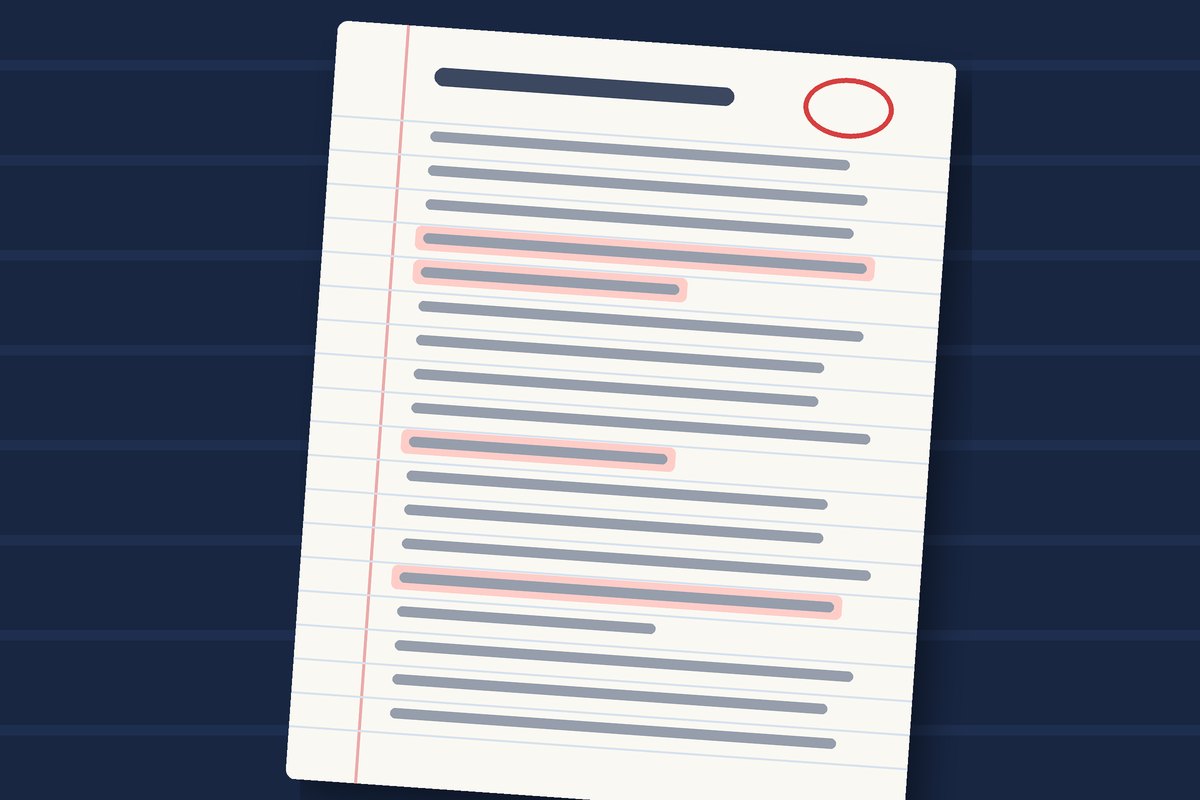
Accused of Using AI on an Essay? Here's What Students Can Actually Do
The email usually arrives a few days after the deadline. A professor writes that your essay "was flagged by our AI detection software" and asks you to come in and talk about it. If you wrote every word yourself, that message is a gut punch. But it's more common than most colleges like to admit, and there is a sensible way to handle it.
The first thing to know is that the flag is not a finding. It is a number produced by a piece of software that guesses, from the shape of your sentences, how likely the text is to have come from a chatbot. Those guesses are wrong often enough that some universities have switched the feature off. Vanderbilt turned off Turnitin's AI indicator in 2023, citing worries about false positives, and OpenAI withdrew its own text classifier that same year because it was not accurate enough. A score can start a conversation; it can't settle one.
Why honest essays get flagged
Detectors look for writing that is predictable (sentences of similar length, safe word choices, a tidy five-paragraph structure, hardly any contractions). Chatbots write like that. And so do careful students who were taught to write formally, and so do students writing in their second language. A 2023 Stanford study found that popular detectors labeled more than half of a set of essays by non-native English speakers as AI-generated, while essays by native-speaking eighth graders were mostly judged correctly. That's no small glitch. The students who work hardest at sounding "correct" are the ones most likely to be accused.
Short assignments make it worse. Much worse. A discussion post of 150 words simply doesn't give a detector enough to go on, and the score it produces is closer to a coin toss than a measurement.
What to do before the meeting
Start by collecting the history of your work. Google Docs and Microsoft Word both keep version history, and it shows the essay growing over hours or days, with false starts and rewrites. That record is the strongest evidence a student can bring, far stronger than any score. Add your notes, outlines, the sources you read, and any feedback you got from a writing center or a classmate.
Next, find out which tool was used and what exactly it reported. "The software says it's AI" is vague. A report that marks particular sentences is something you can respond to line by line, explaining where an idea came from or why a paragraph sounds the way it does.
It also helps to run your own essay through a second checker and see what it says. Tools differ a lot in how they work, and when two of them disagree, that alone tells a reasonable professor the evidence is thin. ScanForAI is one free option built with this situation in mind: it doesn't need an account, it marks the specific lines that read as machine-written and explains why, and it lets you save the result as a PDF to bring along. Its own guidance says plainly that a score is a signal, not a verdict, which is the point you will want to make anyway.
In the room
Stay calm and stay specific. Walk through your draft history. Offer to explain your argument out loud, or to write a short paragraph on the topic in front of the instructor if that would help. Ask, politely, whether the school has a policy on how AI detection results may be used. Many do, and most of those policies say a detector score can't be the only evidence for a misconduct finding.
If the conversation goes badly, you are usually entitled to a formal process with an appeal. Keep copies of every email, and write down what was said in meetings while it is fresh. Student advocates and ombudspersons exist for exactly this.
Checking your work before you hand it in
The better habit is to check before anyone else does. If a paragraph you wrote yourself comes back marked as machine-like, that is useful to know. Often the fix is simple: vary the sentence length, use the contractions you would use when speaking, swap any stock phrase for what you actually mean, and add the specific example only you would think of. Those edits usually make the writing better, too, not just more clearly yours.
What doesn't work is trying to "humanize" chatbot text with a rewriting tool. Detectors change and those tricks stop working. Worse, it puts you on the wrong side of the question your professor is really asking, which is whether the work is yours.
AI detection is going to be part of college for the foreseeable future. Students who keep their drafts, understand what a score can and can't show, and check their own writing first will be in a much stronger position when that email arrives.